


 Free 3D
 3D Print Models
 3D Scans
 Animation & MoCap
 Textures
 Materials
 Skin Reference
 2D Game Assets
 Sound Effects
 Brushes & Tools
 Reference Photos
 Stock Images
 HDR Images
 3ds Max
 Maya
 Blender
 Unreal Engine
 Unity
 ZBrush
 Cinema 4D
 LightWave
 Marmoset
 SketchUp
 FBX
 DAE
 DXF
 GLB

DY Alembic Exporter for Daz Studio 6.26

Not Rated Yet


This Item Was Made Using
! REPORT
NOTE: DIGITAL DOWNLOAD, NOT A PHYSICAL ITEM

Add to Collection

1 Like
Share This Daz Content


Top Rated Vendor

I am a DAZ Studio Content Creator.

License
Extended Use License
This item comes with our Extended Use Licensing. This means that you may use the model for both non-commercial and commercial purposes, in a variety of mediums and applications.
For full license terms, see our 3D Content Licensing Agreement
Item Details
| Vendor: | DaYin |
| Published: | Nov 07, 2026 |
| Download Size: | 254.5 KB |
| Software: | Daz Studio |
| Compatible Figure: | Original Daz Figure |
| dForce: | – |
Included Formats

Statistics
| Favorites: | 0 |
| Likes: | 1 |
| Views: | 211 |
Item Ratings
Not Rated Yet
DY Alembic Exporter for Daz Studio 6.26
DY Alembic Exporter 1.0 — DAZ Studio 6
======================================
Alembic (.abc) exporter plugin for DAZ Studio 6 x64.
REQUIREMENTS
------------
- Windows 10 or Windows 11, 64-bit
- DAZ Studio 6 (built and verified against 6.26.2026.30901)
- Microsoft Visual C++ 2015-2022 Redistributable (x64)
INSTALL
-------
0. If you received this as a .zip download, unblock it BEFORE extracting:
right-click the .zip > Properties > tick "Unblock" > OK
Files that keep the "downloaded from another computer" mark can be held
back by SmartScreen or by an antivirus.
1. Close DAZ Studio completely.
2. Copy
dsp_dazalembicexporter.dll
into the DAZ Studio 6 plugins folder:
C:\Program Files\DAZ 3D\DAZStudio6\plugins\
Adjust the path if DAZ Studio 6 is installed elsewhere.
3. Start DAZ Studio 6.
4. Choose File > Export and select "Alembic Scene (*.abc)".
This plugin is the exporter only. DAZ Studio 6 ships its own Alembic importer
(dsp_dazalembic.dll); the two can be installed at the same time and do not
conflict, because the file names differ.
IF THE PLUGIN DOES NOT APPEAR
-----------------------------
Check the DAZ Studio log first:
%APPDATA%\DAZ 3D\Studio6\log.txt
Two common causes:
1. Application control policy. This machine enforces one, so the DLL is code
signed with a local test certificate (see SIGNING.txt). On a machine that
blocks unsigned DLLs, sign the DLL with your own certificate:
signtool sign /f cert.pfx /p /fd SHA256 ^
dsp_dazalembicexporter.dll
or ask your administrator to allow this specific DLL.
The test certificate is deliberately NOT shipped with this package: a
self-signed certificate in the trusted root lets anyone holding its private
key sign arbitrary DLLs. If you really need to trust the existing signature,
obtain the certificate from the machine that signed the plugin
(thumbprint 3C271A2335BF77133EB1DF4461B640341D558F90) and import it
yourself.
2. SDK version mismatch. DAZ Studio refuses to load a plugin whose embedded SDK
version falls outside the range the application accepts. This package is
built against the 6.26 SDK (reports 6.26.2026.27900) and works with
DAZ Studio 6.26. It will NOT load into 6.25, and a 6.25-built DLL will not
load into 6.26 — both are skipped silently, with no error in the export
list. If you rebuild this plugin yourself, use the SDK that matches your
installed DAZ Studio build.
Also check the plugin log for load errors: %TEMP%\daz_alembic_exporter.log
UNINSTALL
---------
Close DAZ Studio and delete
\plugins\dsp_dazalembicexporter.dll
WHAT IT EXPORTS
---------------
Geometry comes from DAZ's own evaluated mesh, so the result matches the
viewport:
- Catmark, Bilinear, Loop and Catmull-Clark (Legacy) all keep the topology DAZ
produces. Loop therefore comes out as triangles, Legacy keeps its own
smoothing instead of being refined as Catmark.
- Face-varying UVs follow the active UV set, seams included.
- One face set per material, named after the DAZ material.
- The node hierarchy: the figure as a transform, with the attached parts
(eyelashes, tears, eyes, mouth, clothing) underneath it.
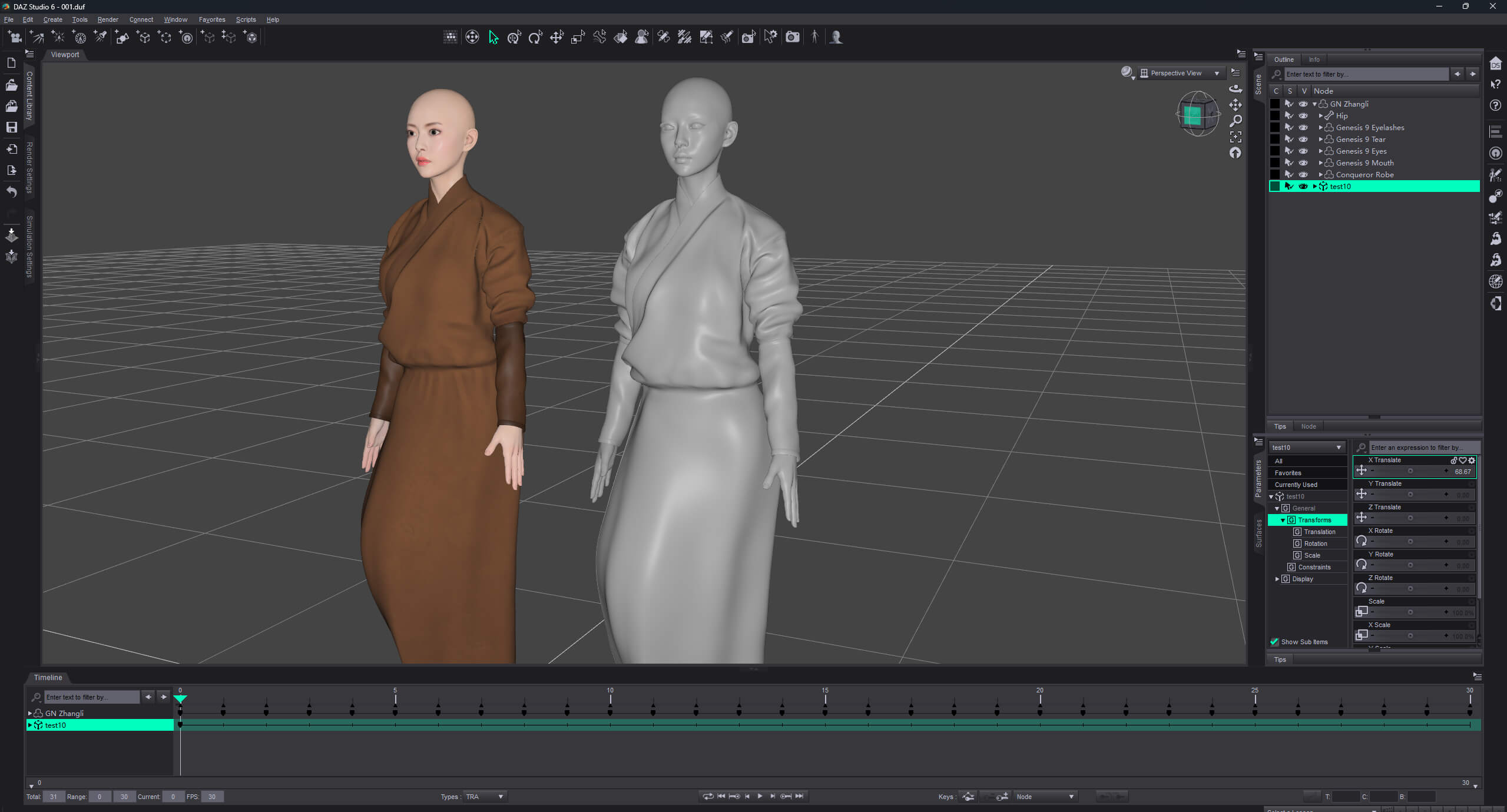
- Animation: one Alembic sample per DAZ frame. Each frame is fully evaluated,
including deformers such as the smoothing modifier, and the exporter waits
until the deferred evaluation has settled before reading it.
USAGE
-----
1. Select a figure, prop, clothing item or hierarchy root in the Scene pane.
With nothing selected, all scene roots are exported.
2. Choose File > Export, select "Alembic Scene (*.abc)", pick a file name.
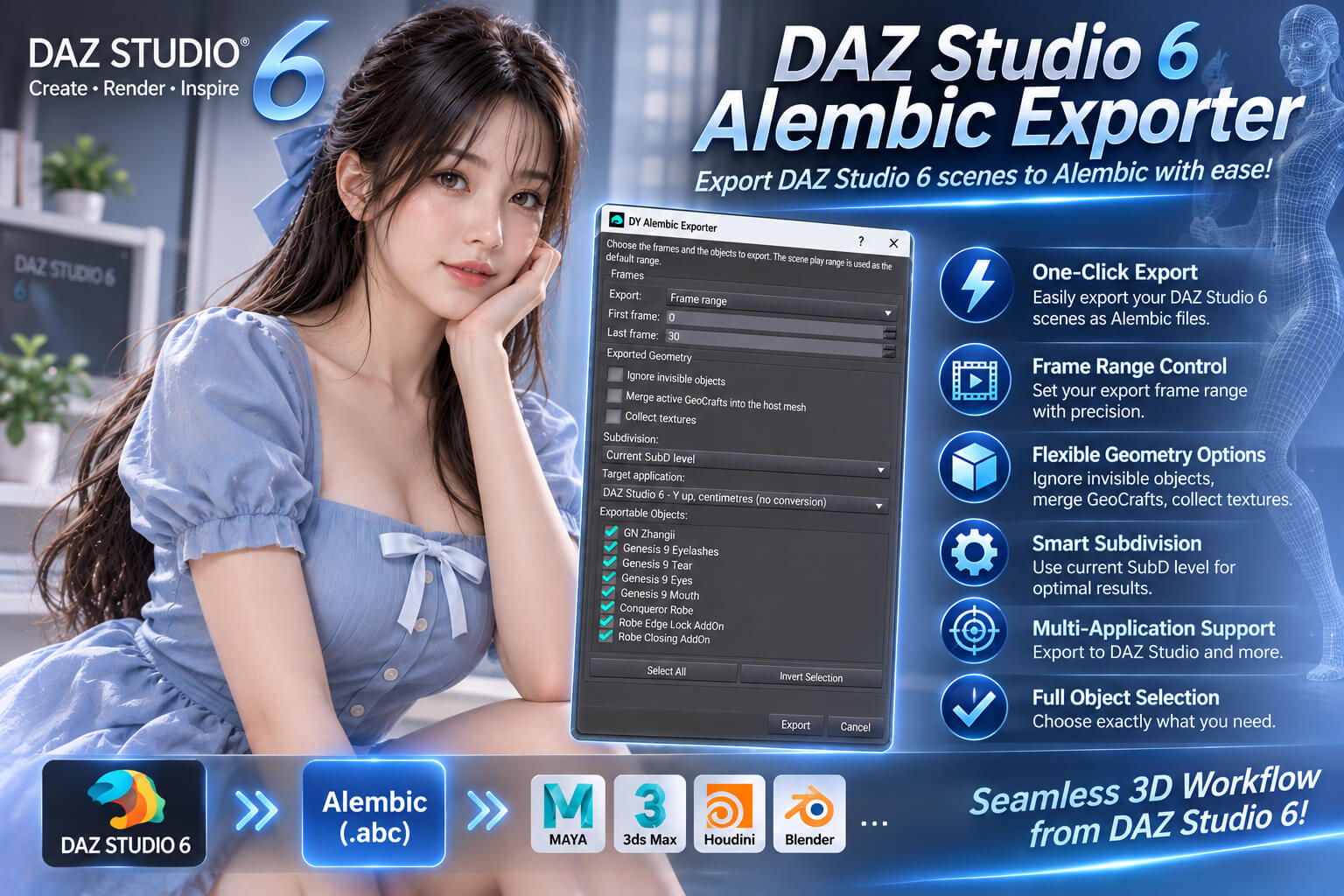
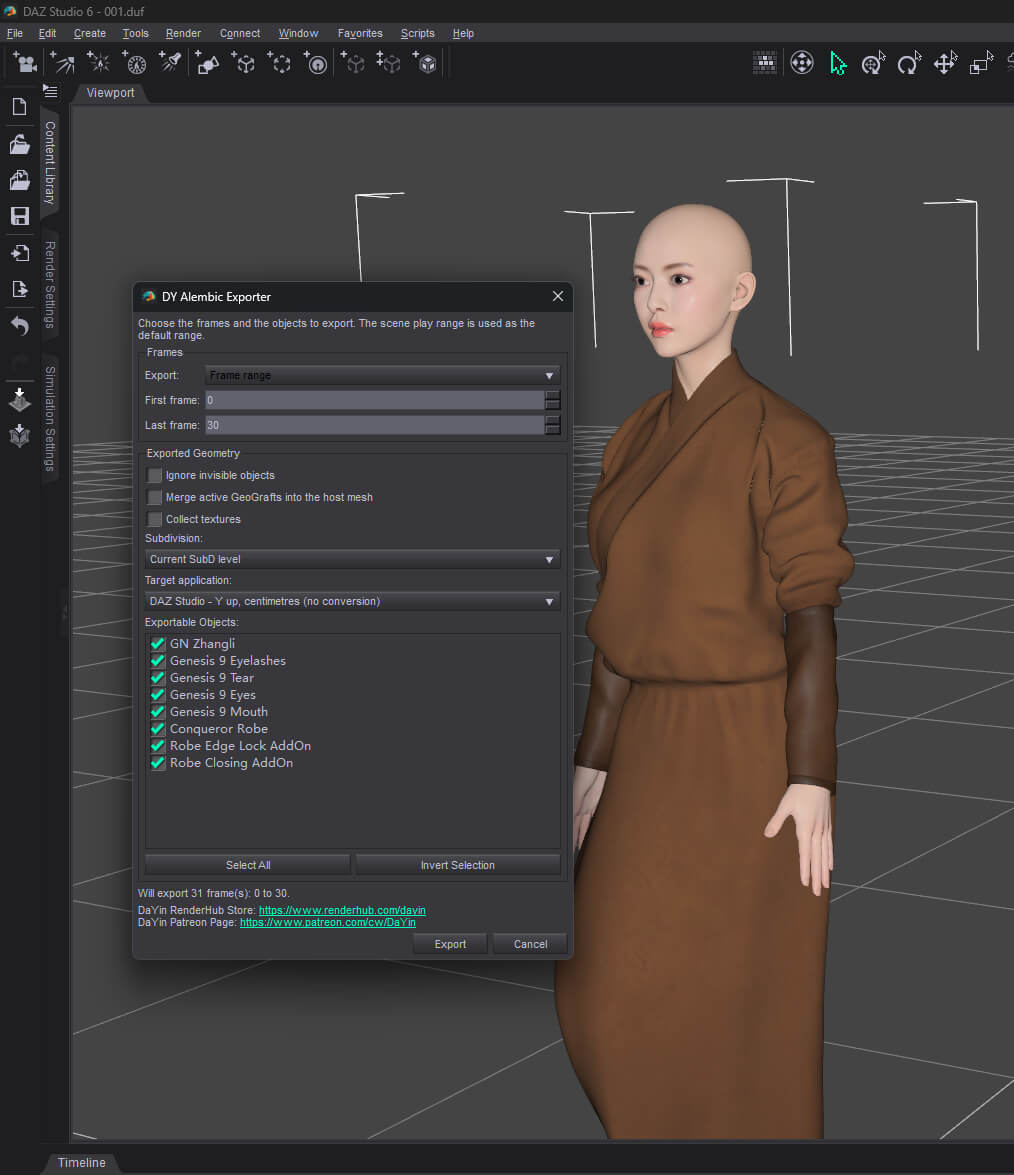
3. In the "DY Alembic Exporter" dialog:
Frames
- Current frame, or a frame range (defaults to the scene play range)
Exported Geometry
- Ignore invisible objects
- Merge active GeoGrafts into the host mesh
Off by default. DAZ already welds active grafts into the host's
evaluated surface, so the graft follower would otherwise be exported
twice. Turning this on drops the duplicate follower and keeps the
graft material as its own face set.
- Collect textures
- Subdivision: SubD Cage (level 0) or Current SubD level (default)
- Target application (see below)
- Object list with Select All / Invert Selection
4. Click Export.
TARGET APPLICATION
------------------
Alembic stores plain numbers; the host application decides the up axis and the
unit scale. The exporter writes one conversion transform above the scene root
and never modifies the mesh data itself.
Target Up axis Scale Extra node
DAZ Studio (default) Y 1 none
Maya Y 1 root_maya
Cinema 4D Y 1 root_cinema4d
Marvelous Designer Y 1 root_marvelous
Houdini Y 0.01 root_houdini
Blender Z 0.01 root_blender
Unreal Z 1 root_unreal
Notes:
- DAZ Studio works in centimetres, so a 172.9 cm figure keeps the value 172.9
for the centimetre targets and becomes 1.729 for the metre targets.
- Blender's Alembic importer already converts Y-up to Z-up, so the Blender
preset only scales; rotating here would lay the figure down.
- Marvelous Designer defaults to millimetres. Either pick "cm (DAZ Studio)" in
its import dialog, or set the unit there to match. The axis conversion can
also be chosen in MD's import dialog.
- The Unreal preset rotates to Z-up but has not been verified on a real import;
if Unreal also converts on import, the rotation must be dropped.
AUTOMATION
----------
Set DAZALEMBIC_EXPORT_NO_DIALOG=1 to skip the dialog.
DAZALEMBIC_EXPORT_MODE=current|range
DAZALEMBIC_EXPORT_START_FRAME=0
DAZALEMBIC_EXPORT_END_FRAME=71
DAZALEMBIC_EXPORT_SUBD=current|cage|0|1|2|3
DAZALEMBIC_EXPORT_TARGET=native|maya|cinema4d|marvelous|houdini|blender|unreal
DAZALEMBIC_EXPORT_GEOGRAFTS=1
DAZALEMBIC_EXPORT_IGNORE_INVISIBLE=1
DAZALEMBIC_EXPORT_COLLECT_TEXTURES=1
DAZALEMBIC_HIGH_RES=1
DAZALEMBIC_LOG=
Note: when running DAZ Studio with -noPrompt, DAZ itself refuses to create any
dialog ("Prompt shown while app is running in noPrompt mode"), so the dialog
must be suppressed with DAZALEMBIC_EXPORT_NO_DIALOG=1 in that mode.
LOG
---
Default log file:
%TEMP%\daz_alembic_exporter.log
Set DAZALEMBIC_LOG to write it elsewhere. The log records, per mesh, the level
that was written, the vertex/face/UV counts, and one "SETTLE" line showing how
many polls were needed before the evaluated mesh stopped changing.
NOTES
-----
- Alembic stores geometry, UVs and face sets, not DAZ materials or texture
links.
- Mesh topology must stay stable across the exported frame range.
- One DAZ frame becomes one Alembic time sample.
- Bake dForce simulations before exporting, so the evaluated cache exists.
- Deformers are read from DAZ's evaluated mesh, so anything that affects the
viewport (morphs, pose, smoothing modifier) is included.
======================================
Alembic (.abc) exporter plugin for DAZ Studio 6 x64.
REQUIREMENTS
------------
- Windows 10 or Windows 11, 64-bit
- DAZ Studio 6 (built and verified against 6.26.2026.30901)
- Microsoft Visual C++ 2015-2022 Redistributable (x64)
INSTALL
-------
0. If you received this as a .zip download, unblock it BEFORE extracting:
right-click the .zip > Properties > tick "Unblock" > OK
Files that keep the "downloaded from another computer" mark can be held
back by SmartScreen or by an antivirus.
1. Close DAZ Studio completely.
2. Copy
dsp_dazalembicexporter.dll
into the DAZ Studio 6 plugins folder:
C:\Program Files\DAZ 3D\DAZStudio6\plugins\
Adjust the path if DAZ Studio 6 is installed elsewhere.
3. Start DAZ Studio 6.
4. Choose File > Export and select "Alembic Scene (*.abc)".
This plugin is the exporter only. DAZ Studio 6 ships its own Alembic importer
(dsp_dazalembic.dll); the two can be installed at the same time and do not
conflict, because the file names differ.
IF THE PLUGIN DOES NOT APPEAR
-----------------------------
Check the DAZ Studio log first:
%APPDATA%\DAZ 3D\Studio6\log.txt
Two common causes:
1. Application control policy. This machine enforces one, so the DLL is code
signed with a local test certificate (see SIGNING.txt). On a machine that
blocks unsigned DLLs, sign the DLL with your own certificate:
signtool sign /f cert.pfx /p /fd SHA256 ^
dsp_dazalembicexporter.dll
or ask your administrator to allow this specific DLL.
The test certificate is deliberately NOT shipped with this package: a
self-signed certificate in the trusted root lets anyone holding its private
key sign arbitrary DLLs. If you really need to trust the existing signature,
obtain the certificate from the machine that signed the plugin
(thumbprint 3C271A2335BF77133EB1DF4461B640341D558F90) and import it
yourself.
2. SDK version mismatch. DAZ Studio refuses to load a plugin whose embedded SDK
version falls outside the range the application accepts. This package is
built against the 6.26 SDK (reports 6.26.2026.27900) and works with
DAZ Studio 6.26. It will NOT load into 6.25, and a 6.25-built DLL will not
load into 6.26 — both are skipped silently, with no error in the export
list. If you rebuild this plugin yourself, use the SDK that matches your
installed DAZ Studio build.
Also check the plugin log for load errors: %TEMP%\daz_alembic_exporter.log
UNINSTALL
---------
Close DAZ Studio and delete
\plugins\dsp_dazalembicexporter.dll
WHAT IT EXPORTS
---------------
Geometry comes from DAZ's own evaluated mesh, so the result matches the
viewport:
- Catmark, Bilinear, Loop and Catmull-Clark (Legacy) all keep the topology DAZ
produces. Loop therefore comes out as triangles, Legacy keeps its own
smoothing instead of being refined as Catmark.
- Face-varying UVs follow the active UV set, seams included.
- One face set per material, named after the DAZ material.
- The node hierarchy: the figure as a transform, with the attached parts
(eyelashes, tears, eyes, mouth, clothing) underneath it.
- Animation: one Alembic sample per DAZ frame. Each frame is fully evaluated,
including deformers such as the smoothing modifier, and the exporter waits
until the deferred evaluation has settled before reading it.
USAGE
-----
1. Select a figure, prop, clothing item or hierarchy root in the Scene pane.
With nothing selected, all scene roots are exported.
2. Choose File > Export, select "Alembic Scene (*.abc)", pick a file name.
3. In the "DY Alembic Exporter" dialog:
Frames
- Current frame, or a frame range (defaults to the scene play range)
Exported Geometry
- Ignore invisible objects
- Merge active GeoGrafts into the host mesh
Off by default. DAZ already welds active grafts into the host's
evaluated surface, so the graft follower would otherwise be exported
twice. Turning this on drops the duplicate follower and keeps the
graft material as its own face set.
- Collect textures
- Subdivision: SubD Cage (level 0) or Current SubD level (default)
- Target application (see below)
- Object list with Select All / Invert Selection
4. Click Export.
TARGET APPLICATION
------------------
Alembic stores plain numbers; the host application decides the up axis and the
unit scale. The exporter writes one conversion transform above the scene root
and never modifies the mesh data itself.
Target Up axis Scale Extra node
DAZ Studio (default) Y 1 none
Maya Y 1 root_maya
Cinema 4D Y 1 root_cinema4d
Marvelous Designer Y 1 root_marvelous
Houdini Y 0.01 root_houdini
Blender Z 0.01 root_blender
Unreal Z 1 root_unreal
Notes:
- DAZ Studio works in centimetres, so a 172.9 cm figure keeps the value 172.9
for the centimetre targets and becomes 1.729 for the metre targets.
- Blender's Alembic importer already converts Y-up to Z-up, so the Blender
preset only scales; rotating here would lay the figure down.
- Marvelous Designer defaults to millimetres. Either pick "cm (DAZ Studio)" in
its import dialog, or set the unit there to match. The axis conversion can
also be chosen in MD's import dialog.
- The Unreal preset rotates to Z-up but has not been verified on a real import;
if Unreal also converts on import, the rotation must be dropped.
AUTOMATION
----------
Set DAZALEMBIC_EXPORT_NO_DIALOG=1 to skip the dialog.
DAZALEMBIC_EXPORT_MODE=current|range
DAZALEMBIC_EXPORT_START_FRAME=0
DAZALEMBIC_EXPORT_END_FRAME=71
DAZALEMBIC_EXPORT_SUBD=current|cage|0|1|2|3
DAZALEMBIC_EXPORT_TARGET=native|maya|cinema4d|marvelous|houdini|blender|unreal
DAZALEMBIC_EXPORT_GEOGRAFTS=1
DAZALEMBIC_EXPORT_IGNORE_INVISIBLE=1
DAZALEMBIC_EXPORT_COLLECT_TEXTURES=1
DAZALEMBIC_HIGH_RES=1
DAZALEMBIC_LOG=
Note: when running DAZ Studio with -noPrompt, DAZ itself refuses to create any
dialog ("Prompt shown while app is running in noPrompt mode"), so the dialog
must be suppressed with DAZALEMBIC_EXPORT_NO_DIALOG=1 in that mode.
LOG
---
Default log file:
%TEMP%\daz_alembic_exporter.log
Set DAZALEMBIC_LOG to write it elsewhere. The log records, per mesh, the level
that was written, the vertex/face/UV counts, and one "SETTLE" line showing how
many polls were needed before the evaluated mesh stopped changing.
NOTES
-----
- Alembic stores geometry, UVs and face sets, not DAZ materials or texture
links.
- Mesh topology must stay stable across the exported frame range.
- One DAZ frame becomes one Alembic time sample.
- Bake dForce simulations before exporting, so the evaluated cache exists.
- Deformers are read from DAZ's evaluated mesh, so anything that affects the
viewport (morphs, pose, smoothing modifier) is included.
